The Recruiter's Reading Habit: F-Pattern Visual Hierarchy That Captures Attention in 6 Seconds
Senior Tech Recruiter @ Career Insight Labs
Jan 13, 2026
Your resume cleared the ATS. Congratulations — that's 1/4 of the battle.
Next, it reaches an invisible battlefield: the recruiter's human screening.
In 12 years of recruiting, here are the physical limits at peak load (80-120 resumes per day):
- Effective attention per resume: 7.4 seconds (TheLadders' eye-tracking study)
- Decision time for
keep readingvsnext: the first 2.4 seconds - Resumes actually read in full: < 12%
What this means: if your resume doesn't grab my eye in the first 2 seconds, no matter how brilliantly the rest is written, I'll never see it.
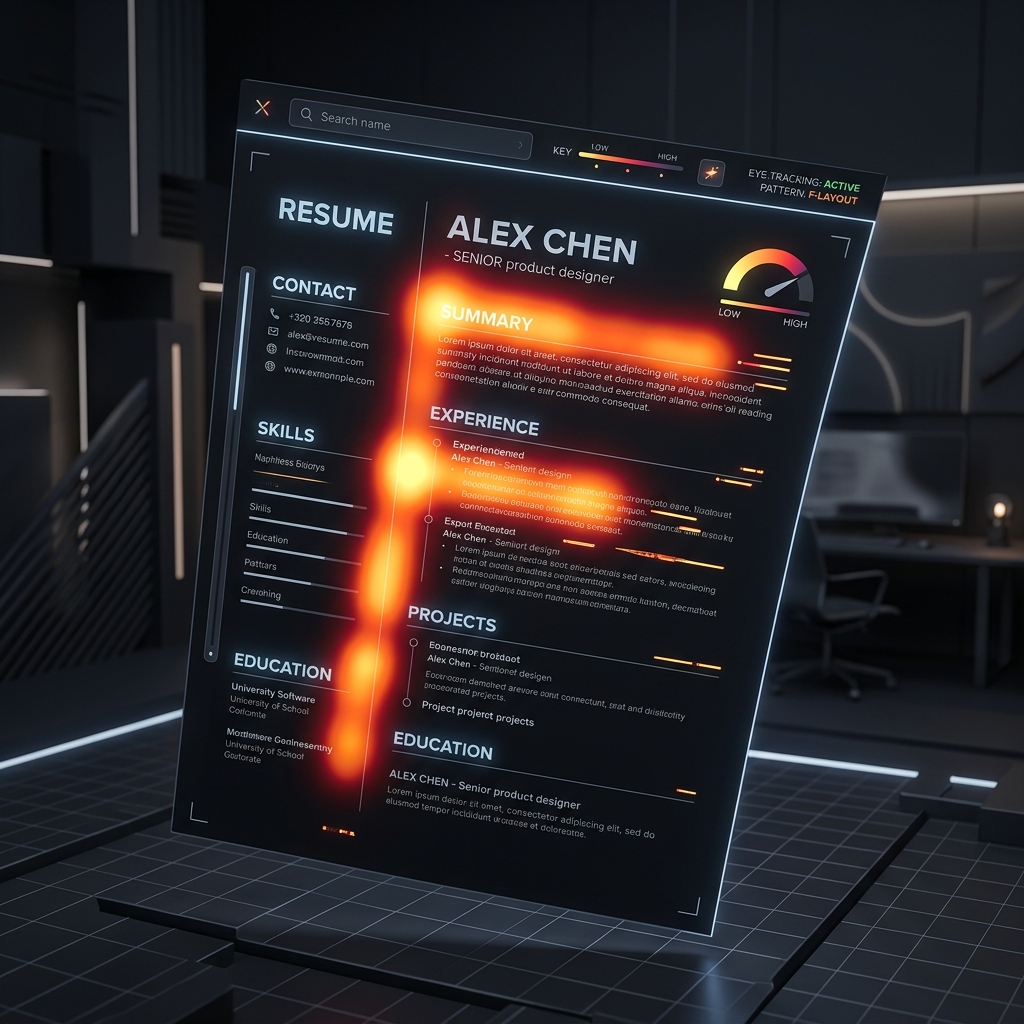
And the recruiter's eye movement isn't random — it's highly predictable. It follows a fixed pattern called the F-Pattern Eye Movement.
Below: what the F-pattern is, how it applies to resume scanning, and how to design 5 "visual anchors" so your resume clears the human gate in 6 seconds.
1. F-Pattern Eye Movement: From Web Usability to Resume Scanning
The F-pattern was first identified in 2006 by usability expert Jakob Nielsen through eye-tracking experiments:
When people quickly scan a page, their eye movement traces an F shape:
- Horizontal scan 1: starting at the top-left, sweep right across one line
- Horizontal scan 2: drop down some distance, sweep right again (typically shorter than the first scan)
- Vertical scan: drop along the left edge to the bottom of the page
█████████████████████████████   ← horizontal scan 1 (most attention)
█████████████████   ← horizontal scan 2 (shorter)
███   ← vertical scan of left-side keywords
███
███
███
This rule holds near 100% for resume scanning — because recruiters use the same rapid-scanning mode as web browsing, not careful reading.
Mapped to a resume:
==============================================================
[Name + one-line positioning]    ← horizontal 1 (longest attention)
[Contact info + LinkedIn + GitHub]   ← first filter pass

WORK EXPERIENCE                  ← visual anchor 1 (must be immediate)
[Current Title + Company + Date] ← horizontal 2 (decisive)
- [First 30 chars of bullet 1]   ← vertical anchor 1
- [First 30 chars of bullet 2]   ← vertical anchor 2
- ...
==============================================================
In 2.4 seconds, the recruiter has read only three things:
- Your name and one-line positioning
- Your current company + title + dates
- The first 5-8 words of the first 2-3 bullets under your current role
Everything else — never registered. Even if the eyes pass over it, the brain doesn't process it.
2. Mapping F-Pattern to Your Resume: 5 Visual Anchor Designs
Knowing the recruiter's eye follows an F-pattern, the design goal becomes clear:
Put your strongest selling points at the 5 anchor positions along the F-pattern path.
Anchor 1: Top "One-Line Positioning" (the core of horizontal 1)
❌ Most people write:
JOHN DOE
john.doe@email.com
+1 415 555 0102
Dry name and contact info. On the first horizontal scan, the recruiter only receives a name — no signal about who you are or what you're worth.
✅ Right:
JOHN DOE  |  Senior Data Engineer · ex-Meta, Stripe · Snowflake + GenAI Infra
john.doe@email.com | +1 415 555 0102 | linkedin.com/in/johndoe | San Francisco, CA
This "one-line positioning" carries 4 key signals:
- Senior Data Engineer: your target title
- ex-Meta, Stripe: credibility / brand endorsement (if you have it)
- Snowflake + GenAI Infra: your core specialty
The recruiter completes the worth continuing decision in 2 seconds.
Anchor 2: Section Headings (let the eye jump to the right region)
❌ Custom flashy headings:
- "My Professional Journey"
- "Where I've Worked"
- "Tech Stuff I Know"
The ATS doesn't recognize them. The recruiter can't find them.
✅ Standardized headings (uppercase + bold + horizontal rule):
WORK EXPERIENCE
———————————————

EDUCATION
———————————

TECHNICAL FOUNDATION
————————————————————
The recruiter's eye is trained to find standard sections in standard locations. Standard naming means they don't have to think.
Anchor 3: Current Role's "Title + Company + Date" Line (core of horizontal 2)
This line is where the recruiter's horizontal-2 scan stops 100% of the time.
❌ Weak version:
Software Engineer
Company X
2022 - Present
Each signal on a different visual line. Attention scatters.
✅ Strong version (single high-density line):
Senior Software Engineer (Tech Lead) | Stripe | Jun 2022 - Present
Design notes:
- Title includes
(Tech Lead)or(Architect-track)— adds a "promotion-track" signal alongside the main title - Bold the company name (or color-contrast in PDF)
- Unified date format:
Jun 2022 - Present, not06/2022 - now
Anchor 4: First 5-8 Words of Each Bullet (the lifeblood of the vertical scan)
The most critical point — during the vertical scan, the recruiter only reads the first 5-8 words of each bullet.
If the first 5-8 words don't grab attention, they skip to the next bullet. If two consecutive bullet prefixes fail to engage, they switch to the next resume.
❌ Weak prefix (no signal in first 5 words):
- Was responsible for designing and...
- Worked closely with team to...
- Used various tools to build...
- Helped improve the performance of...
Reading the first 5 words, the recruiter has already decided to skip.
✅ Strong prefix (all signal in first 5 words):
- Architected a Kafka-to-Snowflake streaming pipeline...
- Cut LLM inference costs by 77% via prompt caching...
- Migrated 240+ legacy Airflow DAGs to dbt...
- Owned $420K Snowflake cost reduction across 4 teams...
- Built production RAG with 87% top-3 accuracy...
The first 5 words of every bullet contain one key signal:
- Strong verb (
Architected / Cut / Migrated / Owned / Built) - Quantified number (
77% / 240+ / $420K / 87%) - Core tech term (
Kafka / Snowflake / LLM / RAG)
One vertical scan, 5 bullets, 5 strong impressions. That's the real game to capture attention in 6 seconds.
Anchor 5: Technical Foundation Section (visual closure)
The recruiter's eye does a "quick verification" at the bottom of the resume — confirming your tech stack aligns with the story your bullets told.
❌ One long flat list:
Skills: Python, Java, Go, SQL, JavaScript, AWS, GCP, Azure, Snowflake,
dbt, Kafka, Spark, Airflow, Kubernetes, Docker, Terraform, Git...
Visually blurry. Attention slips off in 1 second.
✅ Clearly categorized + strong signals first:
TECHNICAL FOUNDATION
————————————————————

Core Languages
- Python (production, 6 yrs), SQL (advanced)

Data Platform
- Snowflake (5 yrs, SnowPro Advanced), dbt (4 yrs),
  Apache Iceberg, Kafka, Spark

GenAI Production Stack
- OpenAI/Anthropic APIs, pgvector, RAG architecture,
  LangSmith eval framework (1 yr production)

Cloud & Infra
- AWS (EKS, S3, Glue, 6 yrs), Terraform, Kubernetes
Each category contains 4-6 skills. Visually scannable, not skippable.
3. Before & After: F-Pattern Visual Optimization
A real candidate's resume rebuild (image-based comparison is limited here — visualize the layout).
❌ Before: Recruiter Discards in 6 Seconds
JOHN DOE
1234 Main Street, Apt 5B, San Francisco, CA 94110
john.doe@email.com
Phone: (415) 555-0102

OBJECTIVE
A passionate and results-driven software engineer seeking a challenging
role in a dynamic organization where I can leverage my skills...

EXPERIENCE
Software Engineer at Tech Company X, San Francisco
June 2022 - Present
Responsibilities:
- Was responsible for designing data pipelines
- Helped the team with various data engineering tasks
- Worked on Snowflake and dbt
- Collaborated with stakeholders
- Used Python for scripting
- Maintained existing systems
Recruiter visual trace:
- Horizontal 1: sees name + long address (low information density, wastes attention)
- Horizontal 2: sees
OBJECTIVE(instant rejection — no one writes Objective in 2026) - Vertical scan: 5 bullets all start with
Was/Helped/Worked/Used/Maintained→ 0 strong signals
Result: tossed into the Not a fit pile after 6 seconds.
✅ After: F-Pattern Optimized
JOHN DOE  |  Senior Data Engineer · ex-Meta · Snowflake + GenAI Infra
john.doe@email.com | (415) 555-0102 | linkedin.com/in/johndoe | github.com/johndoe
San Francisco, CA

——————————————————————————————————————————————————————————
WORK EXPERIENCE
——————————————————————————————————————————————————————————

Senior Data Engineer (Tech Lead)  |  Stripe  |  Jun 2022 - Present

- Architected a Kafka-to-Snowflake streaming pipeline handling 3.2B
  events/day, cutting analytics latency from 6h to 8min and saving
  $180K/year in compute.

- Cut LLM inference costs by 77% ($48K → $11K/month) via prompt
  caching, batch API, and tier-based model routing across 6 prod
  agents.

- Migrated 240+ legacy Airflow DAGs to dbt + Snowpark, reducing
  pipeline maintenance overhead by 60% and freeing 30% team capacity.

- Owned $420K Snowflake cost reduction across 4 product teams via
  Python-based query analyzers and warehouse rightsizing.

- Built production RAG (pgvector + text-embedding-3-large + Cohere
  Rerank) achieving 87% top-3 accuracy, serving 800 QPS at p99 < 40ms.

——————————————————————————————————————————————————————————
TECHNICAL FOUNDATION
——————————————————————————————————————————————————————————

Core: Python (6 yrs), SQL (advanced)
Data Platform: Snowflake (SnowPro Advanced), dbt, Kafka, Spark, Iceberg
GenAI Stack: OpenAI/Anthropic APIs, pgvector, RAG, LangSmith eval (1 yr prod)
Cloud & Infra: AWS (EKS, S3, Glue), Terraform, Kubernetes
Recruiter visual trace:
- Horizontal 1: sees
Senior Data Engineer · ex-Meta · Snowflake + GenAI→ positioning done in 2 seconds - Horizontal 2: sees
Senior Data Engineer (Tech Lead) | Stripe | Jun 2022 - Present→ title progression + brand endorsement - Vertical scan: 5 bullet prefixes —
Architected / Cut 77% / Migrated 240+ / Owned $420K / Built RAG 87%→ 5 strong-signal hits - Visual closure: Technical Foundation clearly categorized, Snowflake/RAG keywords reinforced
Result: moved into the Phone screen ASAP queue after 6 seconds.
Same person. Same work. Same skills. Just visual anchors redesigned.
4. The 7-Item F-Pattern Optimization Checklist
Print this and tape it next to your monitor. Run through it every time you update your resume:
- ✅ Does the top line contain a one-line positioning (title + brand endorsement + core specialty)?
- ✅ Is contact info on line 2, immediately under the name (not in Header/Footer)?
- ✅ Removed the
Objective/Summaryparagraphs? (Unless you're a domain switcher.) - ✅ Are section headings in uppercase + standard naming + separated by a horizontal rule?
- ✅ Does the current Title line carry a
promotion signal(e.g.,Tech Lead/Architect-track)? - ✅ Do the first 5-8 words of every bullet contain strong verb + quantified number + core tech term?
- ✅ Is Technical Foundation split into 3-5 categories, 4-6 skills each, with the most important first?
Any "no" → fix it.
5. The Counter-Intuitive Truth About Whitespace
Many candidates think dense = more value. Filling the page = showing more content.
This logic is fatal under the F-pattern.
A densely packed resume gives the recruiter's eye nowhere to land — everything looks "important," nothing actually registers.
The right approach is deliberate whitespace:
- One blank line between sections
- One blank line between work experience entries
- Single bullet kept to under 2 lines
- 0.7-inch page margins (don't crush margins to 0.4 inch to fit more content)
Whitespace isn't wasted space — whitespace guides the recruiter's eye to what you want them to see.
6. CTA: Your Resume Has to Win Two Wars Simultaneously
To summarize:
A resume that wins interviews must win two wars in parallel:
- The ATS algorithm war: parsing rate, keywords, semantic matching
- The human-recruiter war: F-pattern visual flow, anchor design, 6-second attention capture
Few candidates solve both. Either the ATS passes but the visual layout collapses, or Canva looks beautiful but the ATS auto-rejects.
This is the core promise of AI-Resume-Builder:
Our real-time preview panel is designed against the eye-tracking heatmaps of top recruiters.
- The editor simulates the recruiter's 6-second scan path in real time
- It scores each "visual anchor" of your resume (top positioning / Title line / bullet prefix / Skills grouping)
- It auto-detects whether the first 5 words of every bullet carry strong signal
- An ATS simulator runs in the backend simultaneously, ensuring you clear both the algorithm and the human layer
You only need to tell your work story clearly. We win both visual wars on your behalf.
👉 Try AI-Resume-Builder for free — see how your resume scores on the 6-second scan
SEO Tags (Technical SEO Output)
HTML <title> tag
<title>F-Pattern Resume Layout: Capture Recruiter Attention in 6 Seconds</title>
<meta description>
<meta name="description" content="Recruiters average 7.4 seconds per resume — eye movement follows an F-pattern. A Senior Recruiter breaks down 5 visual anchor designs, from top positioning to bullet prefixes, to clear human screening in 6 seconds.">
Schema.org JSON-LD
{
  "@context": "https://schema.org",
  "@type": "Article",
  "headline": "The Recruiter's Reading Habit: F-Pattern Visual Hierarchy That Captures Attention in 6 Seconds",
  "description": "A deep analysis of the F-Pattern Eye Movement that recruiters use when scanning resumes, breaking down 5 visual anchor designs (top positioning, section headings, Title line, bullet prefixes, Technical Foundation grouping) with a Before/After visual heatmap rebuild.",
  "image": "https://ai-resume-builder.com/og/f-pattern-resume-design.png",
  "author": {
    "@type": "Person",
    "name": "Senior Tech Recruiter",
    "url": "https://ai-resume-builder.com/about"
  },
  "publisher": {
    "@type": "Organization",
    "name": "AI-Resume-Builder",
    "logo": {
      "@type": "ImageObject",
      "url": "https://ai-resume-builder.com/logo.png"
    }
  },
  "datePublished": "2026-06-06",
  "dateModified": "2026-06-06",
  "mainEntityOfPage": {
    "@type": "WebPage",
    "@id": "https://ai-resume-builder.com/blog/f-pattern-visual-hierarchy-6-seconds"
  },
  "keywords": "F-pattern resume layout, eye-tracking heatmap resume, 6 second resume scan, recruiter visual hierarchy, resume bullet prefix, ATS plus human screening"
}