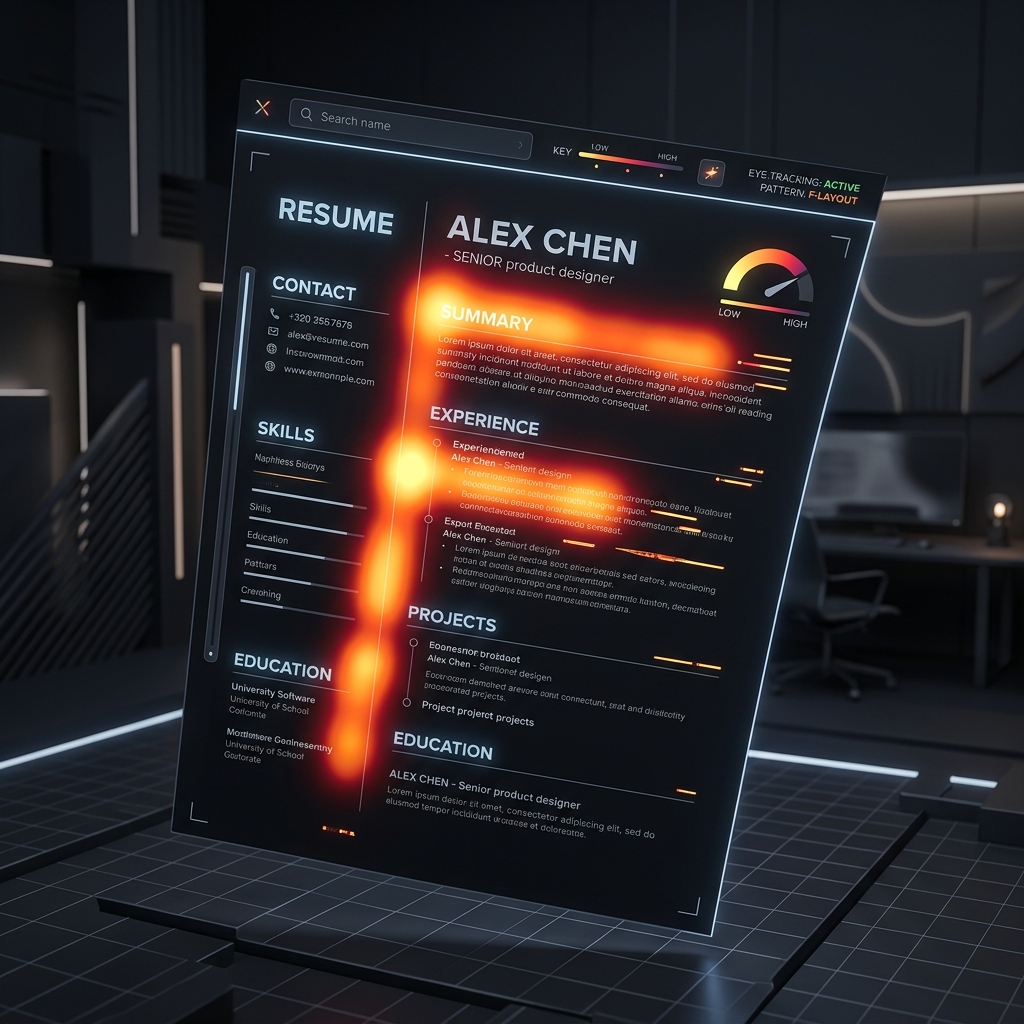
Your Performance Review Is Sitting on a Resume Goldmine: Turn Self-Review Bullets Into Interview-Ready Stories
Senior Tech Recruiter @ Career Insight Labs
Mar 8, 2026

Every year, engineers at companies with formal review cycles write 2,000-5,000 words of self-review: projects shipped, metrics moved, conflicts navigated, teams led, people mentored, systems designed. It's the most detailed, evidence-rich document about their professional impact that they will ever produce.
And then they never touch it again.
Meanwhile, their resume — the document that actually determines whether they get interviews — sits at 400 words of generic bullet points that haven't been updated in 18 months. The disconnect is staggering. I've seen engineers write 3,000 words of detailed self-review and then summarize their entire year on their resume as "Built features and improved system performance."
This article covers: why self-reviews are better resume source material than anything you'll produce from scratch, a 3-step pipeline for converting self-review content into resume bullets, what to steal from peer reviews and manager feedback, and a Before/After showing the difference between a resume written from memory vs. one mined from performance reviews.
1. Why Self-Reviews Beat "Writing From Memory"
When you update your resume by sitting down and trying to remember what you did, three things happen:
- Recency bias: You remember what you did in the last 3 months. The other 9 months of the year become "worked on various features."
- Specificity decay: You know you "improved performance" but you can't remember the exact number — was it 40% or 60%? So you write neither.
- Impact amnesia: You forget the business context. That pipeline you built? You forget that it enabled a product launch that generated $4M. You just remember the pipeline.
Your self-review, written closer to the events, captures all three before they fade. The numbers are fresh. The context is documented. The impact is explicit — because you had to justify your rating to your manager.
What a self-review contains that a from-memory resume misses:
| Self-review content | Resume value |
|---|---|
| "Reduced P99 latency from 850ms to 210ms by implementing connection pooling and query batching" | Specific metric + technique — both recruiter and hiring manager gold |
| "This project was initially blocked by the Data Infra team's deprecation timeline. I proposed an interim solution using read replicas that unblocked us without waiting for the full migration." | Problem-solving narrative, cross-team influence, autonomy — interview story ready-made |
| "I mentored Alex through their first production Kotlin service, reviewing 40+ PRs over 3 months. Alex is now independently owning the notifications service." | People development with timeline, intensity, and outcome — management signal |
| "The initial approach of using a graph DB was abandoned after benchmarking showed 12× slower query performance than a denormalized PostgreSQL schema." | Technical judgment, data-driven decision making, willingness to pivot — Senior+ signal |
2. The 3-Step Self-Review → Resume Pipeline
Step 1: Extract the "Quantified Outcomes" Section
Every self-review contains a section where you list your accomplishments. Go through it and pull out every sentence that contains a number — latency, throughput, cost, revenue, users, teams, time saved, error rates. These are your raw resume bullets.
Self-review raw material:
"Migrated the checkout service from Python to Go, which involved rewriting 12 endpoints, redesigning the database access layer, and running shadow traffic for 3 weeks to validate correctness before the cutover."
Extracted numbers: 12 endpoints, 3 weeks shadow traffic, [missing: latency impact, throughput impact, error rate impact].
If your self-review is missing the outcome numbers, that's a fixable problem — go find them. Check your project tracking tools, dashboards, or the original launch announcement. If you can't find exact numbers, use conservative estimates and mark them as "~" in your resume draft. But get the numbers. A resume bullet without an outcome number is a claim without evidence.
Step 2: Identify the "Story Moments"
Your self-review also contains narrative moments — problems you solved, conflicts you navigated, decisions you made under uncertainty. These are not resume bullets (too long). They're interview story seeds.
Self-review raw material:
"When the ML team's model update unexpectedly changed the output format of the recommendation API, it broke our product detail page for 6 hours. I identified the root cause within 30 minutes by tracing the API response schema change, built a schema-validation layer in the integration, and worked with the ML team to establish a contract-testing pipeline that now catches schema changes before deployment."
Resume bullet version: "Built a schema-validation layer and established contract-testing pipelines with the ML team after a production incident, eliminating a failure class that had caused 6 hours of downtime."
Interview story seed: Keep the full narrative — this is a CARR story (Context: model update broke the API; Action: traced, fixed, built validation; Result: contract testing prevents recurrence; Reflection: cross-team API contracts need automated enforcement). Article 15 covers how to structure this for interviews.
Step 3: Steal From Your Peer Reviews and Manager Feedback
The most overlooked resume goldmine: what OTHER people wrote about you.
If your company uses 360 review, read your peer feedback again. When a peer writes "Sarah's code reviews are the most thorough on the team — she catches edge cases that would have caused production issues," that's a resume bullet you would never write about yourself. But you should.
Peer review → Resume bullet:
- Peer: "Sarah's code reviews caught 3 potential production issues this quarter."
- Resume: "Established code review practices that caught 3 potential production issues before deployment across the team's 6 services."
Manager review → Resume bullet:
- Manager: "James showed strong leadership in aligning the mobile and backend teams on the API contract."
- Resume: "Aligned mobile and backend teams (12 engineers) on API contract standards, reducing integration issues by an estimated 60%."
Your peers and manager are giving you resume bullets for free. You just need to copy them.
3. What to Steal From Each Review Artifact
| Artifact | What to mine | How to use it |
|---|---|---|
| Self-review accomplishments | Numbers, metrics, scope | Resume bullets (quantified) |
| Self-review narratives | Problems solved, decisions made | Interview story seeds (CARR/DIGS framework) |
| Peer reviews | Strengths others noticed, specific praise with examples | Resume bullets you'd never write yourself |
| Manager review | Leadership signals, business impact, promotion justification | Resume summary, LinkedIn About section |
| Promotion doc / packet | Most comprehensive list of impact across quarters | The single best source for a full resume rewrite |
| Launch announcements / post-mortems | Project scope, team size, timeline, impact | Context and scale for resume bullets |
| OKR tracking | Metrics over time, goal achievement rates | Trend data for resume bullets ("improved X by Y% over Z quarters") |
If your company doesn't do formal reviews, create your own artifact. Once a quarter, spend 30 minutes writing down: what you shipped, what metrics moved, what problems you solved, who you helped, and what you learned. A "personal quarterly review" that takes 30 minutes now saves you 4 hours of frustrated memory-searching when you update your resume later.
4. Before & After: Memory Resume vs. Review-Mined Resume
❌ Before: The "From Memory" Resume
WORK EXPERIENCE
Senior Software Engineer | SaaSCompany | 2022-Present
- Built and maintained backend services for the platform
- Improved API performance and reduced latency
- Worked on the migration to microservices
- Mentored junior developers on the team
- Participated in on-call rotation and incident response
- Collaborated with product team on new features
What this signals: "I did things. I don't remember exactly what or how much. Please don't ask."
✅ After: The "Mined From Reviews" Resume (Same Person)
WORK EXPERIENCE
Senior Software Engineer (promoted from SWE II, Q3 2023) | SaaSCompany
(320-person B2B SaaS, $42M ARR) | 2022-Present

- Redesigned the API gateway's connection pooling and query batching layer,
  reducing P99 latency from 850ms to 210ms across 14 endpoints serving 22K
  QPS. The latency reduction was directly cited by 3 enterprise customers
  in contract renewal conversations ($1.8M combined ACV).

- Led the checkout service migration from Python to Go: rewrote 12 API
  endpoints, redesigned the database access layer (SQLAlchemy → sqlc +
  pgx), and ran 3 weeks of shadow traffic validation. Cut per-transaction
  infrastructure cost by 62% ($14K/month → $5.3K/month) and improved
  throughput from 400 TPS to 1,100 TPS.

- Built a schema-validation layer between the recommendation API and
  product detail page after a model-output change caused 6 hours of
  downtime. Established a cross-team contract-testing pipeline with the
  ML team that now catches schema changes pre-deployment, eliminating
  that entire failure class.

- Developed 2 engineers through structured growth plans over 8 months:
  assigned incrementally-scoped ownership, conducted 40+ code reviews
  per engineer, and advocated for both promotions — approved Q1 2025.
  (Peer review: "Best code reviewer on the team. Catches edge cases
  that would have caused production issues.")

- Reduced team on-call alert fatigue from 42 alerts/week to 9 alerts/week
  by tuning alert thresholds, eliminating 6 noisy alerts, and building 3
  auto-remediation runbooks. Reduced mean-time-to-resolution from 47 min
  to 12 min.
The source mapping:
- Bullet 1: Q3 2023 self-review accomplishments section
- Bullet 2: Q4 2023-Q1 2024 self-review + project post-mortem metrics
- Bullet 3: Q2 2024 incident post-mortem + peer review mention of "thorough code reviews"
- Bullet 4: Q3-Q4 2024 manager review ("strong mentorship") + peer review verbatim quote
- Bullet 5: Q1 2025 on-call retrospective data
Every bullet has a source document. Nothing was written from memory. The result is a resume where every claim is backed by evidence — and where the recruiter and hiring manager can both see exactly what this person delivered.
5. Three Common Performance Review → Resume Mistakes
Mistake 1: Copying Self-Review Language Verbatim
Self-reviews are written for your manager — someone who already knows the context. Resumes are written for strangers who know nothing about your company, your team, or your systems.
❌ Self-review language: "Migrated the checkout service to Go." (Manager knows what the checkout service is, how critical it is, and that a rewrite is hard.)
✅ Resume language: "Migrated the checkout service from Python to Go, rewriting 12 API endpoints handling 400 TPS of payment transactions — cut per-transaction cost by 62% and improved throughput by 2.75×."
Add the context your manager already has. A stranger reading your resume has none.
Mistake 2: Using Internal Jargon
"Led the Atlas-to-Helios migration for the Bazaar squad" means nothing to a recruiter. Translate internal project names, team names, and system names into plain English:
✅ "Led the migration of 6 backend services from ECS to Kubernetes (codename Atlas-to-Helios) for the Payments team, serving 400 TPS across the checkout and billing platforms."
Mistake 3: Not Updating Quarterly
Your self-review is written once or twice a year. Your resume should be updated at the same cadence. The "annual resume update" is a ritual that takes 30 minutes and ensures your resume is never more than 6 months stale.
Schedule it: every time you submit a self-review, spend 30 minutes updating your resume with the 3-5 strongest bullets from that review. After 2 years, you'll have a resume that's dense with quantified evidence — and you'll never have to do a panicked "I need a resume by Friday" rewrite again.
6. CTA: Turn Your Performance Reviews Into a Resume That Actually Shows Your Impact
Your self-reviews, peer feedback, and manager evaluations contain better resume material than you'll ever produce from memory. The gap isn't in your material — it's in the extraction.
At AI-Resume-Builder, we built a Review-to-Resume Extractor that:
- Ingests your self-review, peer reviews, and manager feedback (you paste them in, nothing leaves your session)
- Auto-extracts every quantified outcome — numbers you might have missed because you're too close to the work
- Identifies "story seeds" — narrative moments from your reviews that map to CARR/DIGS interview frameworks
- Flags what's missing: numbers you didn't include, context a stranger won't have, internal jargon that needs translation
- Generates resume-ready bullets from review content — maintaining the evidence density that makes reviews valuable while compressing them into recruiter-scannable format
- Creates an annual-update reminder so your resume never goes stale again
The best resume update you'll ever do is the one where you don't have to remember anything.
👉 Extract your performance reviews into resume bullets — free
SEO Tags (Technical SEO Output)
HTML <title> tag
<title>Performance Review to Resume: Turn Self-Evals Into Job-Winning Bullets</title>
<meta description>
<meta name="description" content="Your performance reviews contain better resume material than anything you'll write from memory. A recruiter shares a 3-step pipeline to extract quantified outcomes, story seeds, and peer praise into interview-ready resume bullets.">
Schema.org JSON-LD
{
  "@context": "https://schema.org",
  "@type": "Article",
  "headline": "Your Performance Review Is Sitting on a Resume Goldmine: Turn Self-Review Bullets Into Interview-Ready Stories",
  "description": "A practical guide for mining performance reviews, self-evaluations, peer feedback, and manager assessments for resume content — covering a 3-step extraction pipeline, what to steal from each review artifact, a complete Before/After resume transformation, and strategies for maintaining a perpetually-updated resume.",
  "image": "https://ai-resume-builder.com/og/performance-review-resume.png",
  "author": {
    "@type": "Person",
    "name": "Senior Tech Recruiter",
    "url": "https://ai-resume-builder.com/about"
  },
  "publisher": {
    "@type": "Organization",
    "name": "AI-Resume-Builder",
    "logo": {
      "@type": "ImageObject",
      "url": "https://ai-resume-builder.com/logo.png"
    }
  },
  "datePublished": "2026-06-13",
  "dateModified": "2026-06-13",
  "mainEntityOfPage": {
    "@type": "WebPage",
    "@id": "https://ai-resume-builder.com/blog/performance-review-resume-goldmine"
  },
  "keywords": "performance review resume, self evaluation for resume, self-review to resume bullets, how to update resume after review, peer review resume content, annual review resume update, resume from performance data"
}